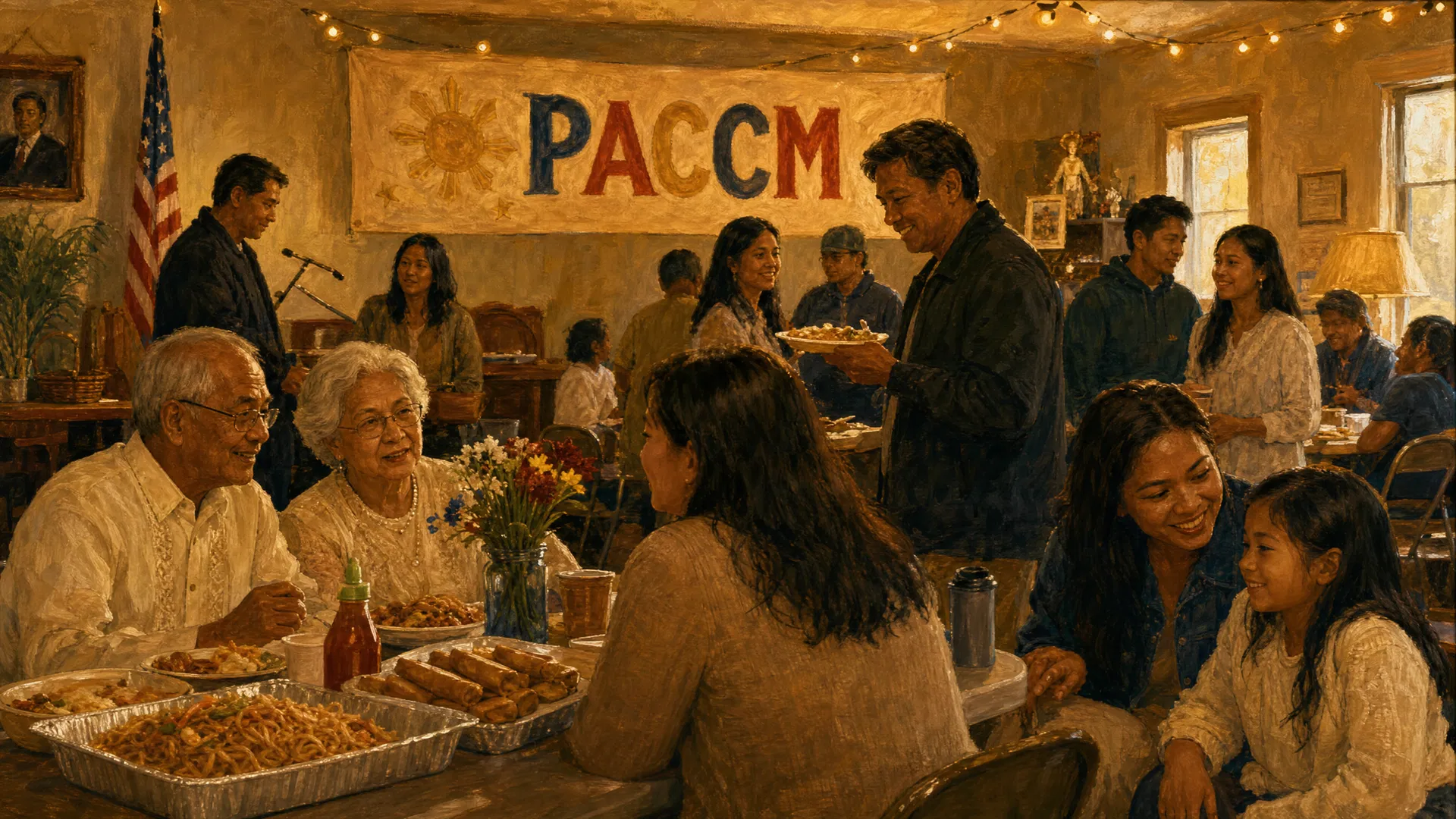
Against All Odds, It Worked: The New PACCM and What It Says About Us
It was haphazard. There was no financial model. The city hadn't even approved it yet. And somehow, it opened anyway. Let's talk about that.
If you grew up Filipino in Michigan in the 1990s or early 2000s, you know the PACCM. The Philippine American Community Center of Michigan on Eight Mile was not glamorous. It was not a sprawling banquet hall like the Polish Center or the San Marino Club. It did not have valet parking or a catering kitchen that could handle 500 guests. But it was ours, and that distinction — that small, stubborn fact of ownership — meant everything.
Birthdays were held there. Wedding receptions. Christmas parties, concerts, community get-togethers that stretched late into the night with pancit and karaoke and the particular kind of noise that only happens when Filipinos are genuinely happy. A lot of us who are now in our 30s and 40s have a memory tied to that building. It took a long time for the community to pull together the donations and the effort to make it happen, but we did, and for years it held us.
The Decision That Divided the Room
Approximately two years ago, PACCM President Becky Tungol — by any measure, a committed and tireless leader — made a decision that was not popular. The Eight Mile location was sold. The community's assets were moved into a new, raw space a few miles down the road in Southfield, before the city or the state had formally approved the location, and without a financial model in place to support the transition.
To anyone with a business background, the alarm bells were immediate and loud. The PACCM was not a profitable organization. It had no full-time executive director. Its membership model had long been questioned. It ran on donations, on goodwill, on the volunteer hours of people who cared enough to show up. And now, all of its assets had been committed to a building that might not even be approved.
The naysayers were not wrong to be skeptical. The critics were not wrong to ask hard questions. That is worth saying plainly, because what comes next should not erase the legitimate concerns that were raised.
It Worked Anyway
The center is open. It is functional. Against the weight of every structural problem stacked against it — no financial plan, no executive leadership, no guarantee of approval — the new PACCM exists.
How? Faith, for those who hold it. Grit, for everyone. The steadfastness of Becky Tungol, who absorbed years of criticism and doubt and kept moving. The generosity of community members who gave money, time, and labor to a project that looked, on paper, like it should not have succeeded. The Filipino community in Michigan, for all of its organizational dysfunction, found a way to do what it has always done when the stakes are high enough: show up.
This is not a story about good planning. It is a story about something harder to quantify and harder to replicate — the capacity of a community to will something into existence through sheer collective stubbornness. We should be honest about what it was. And we should be grateful it worked.
The Harder Conversation Ahead
There is a version of this article that spends its remaining paragraphs cataloguing everything that still needs to be fixed. The membership model. The absence of full-time professional leadership. The financial sustainability questions that did not disappear when the doors opened. We will get to all of that — because those problems are real, and ignoring them is how you end up having this same conversation in five years about a different building.
But that is a conversation for another day, and another article.
For now, the more useful question is the one that the PACCM's unlikely survival raises about our community's potential: What would it look like if we did this on purpose?
The Chaldean community in metro Detroit has a community infrastructure that is the envy of every immigrant group in the region. The Chinese Benevolent Association — which originated on the West Coast over a century ago — built not just community centers but business templates, funding networks, and institutional knowledge that has been passed down across generations. There are actual playbooks for how to start a Chinese restaurant, how to access community capital, how to navigate the systems that immigrant communities face. The infrastructure exists because someone, generations ago, decided to build it intentionally.
Could the Filipino community in Michigan ever get that sophisticated? Could we build something that does not depend on one extraordinary leader absorbing all the risk? Could we develop a financial model, a membership structure, a governance system that does not require a miracle to function?
These are open questions. The answers depend on whether we are willing to be honest about our patterns — the pride, the politics, the tendency to critique from the sidelines and disappear when the work begins — and whether the next generation of leaders will demand something better than what we have inherited.
Thank You, Becky
None of that future work diminishes what happened here. A community center that should not have survived its own founding is open. People will make memories there. Children will grow up knowing it as theirs.
Thank you to Becky Tungol and everyone who made this possible. Here is to the new PACCM — and to the harder, more intentional work of building something that lasts.
Anak ng Bayan — Anak ng Bayan is a pseudonymous writer with deep roots in the Michigan Filipino community. They write about culture, institutions, and the complicated business of belonging.
Letters to the Editor
No letters published yet. Be the first to write in.
Community Response
1More From Unphiltered Michigan
The BG Wealth Illusion: How 'Bayanihan' Became a $150 Million Ponzi Scheme
It usually starts at a party. You're holding a paper plate heavy with pancit and a slightly burnt lumpia when someone — a nurse, a church elder, that uncle who always has a new car — pulls you aside. 'Anak,' they whisper. 'Have you heard about BG Wealth? I just doubled my money in two months.' And just like that, the trap is set. Thirteen regulators warned the public. $150 million is already gone.
World Financial Group: The MLM That Ate Your Tito's Retirement
We all have that one relative. They show up to the family picnic in a slightly oversized suit, carrying a faux-leather briefcase, and suddenly the conversation shifts from PBA scores to your 'financial future.' They aren't asking about your life — they're sizing up your wallet. Welcome to World Financial Group, the MLM that has sunk its teeth so deeply into the Filipino-American community it's practically a rite of passage.
never knew this much history about paccm tbh. my parents always mentioned it but never explained it like this. respect to everyone who made it happen