The BG Wealth Illusion: How 'Bayanihan' Became a $150 Million Ponzi Scheme
Thirteen regulators warned the public. The scheme ran for twelve months anyway. The reason why says everything about us.
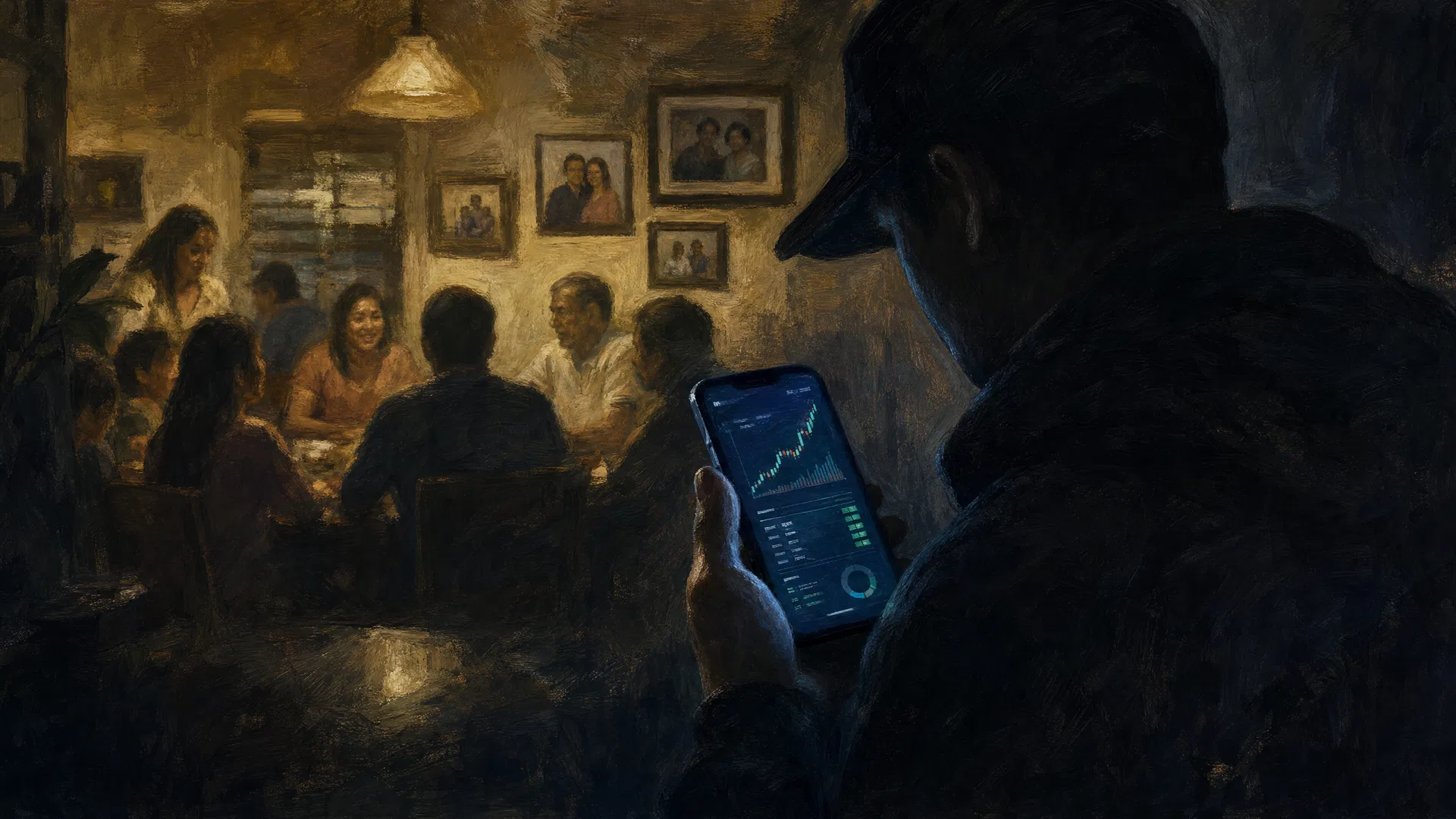
It usually starts at a party. You're holding a paper plate heavy with pancit and a slightly burnt lumpia, trying to avoid eye contact with the Tita asking why you aren't married yet. Then, someone — usually a respected nurse, a church elder, or that one uncle who always seems to have a new car — pulls you aside.
"Anak," they say, their voice dropping to a conspiratorial whisper. "Have you heard about this new trading platform? It's called BG Wealth. I just doubled my money in two months. It's an AI bot. You just copy and paste the signals. It takes five minutes a day."
And just like that, the trap is set.
Over the past year, the BG Wealth Sharing scheme and its associated fake crypto exchange, DSJ Exchange (DSJEX), tore through the Filipino-American community in Michigan like a winter squall off Lake Huron. It wasn't a small-time hustle. According to on-chain investigator ZachXBT, who helped unravel the scheme in May 2026, total victim losses exceeded $150 million worldwide — with more than $92 million laundered across blockchains in a single frantic 72-hour window before the collapse.
But the numbers, as staggering as they are, don't capture the real story. The real story is about us.
They Knew. For a Full Year.
Here is the fact that should make every member of our community sit with their discomfort for a moment: thirteen regulatory agencies across five continents warned the public about this scheme, and it kept running for nearly twelve months.
The UK's Financial Conduct Authority flagged DSJ Exchange as unauthorized as early as May 2025. New Zealand's Financial Markets Authority blacklisted it. Tonga's central bank issued a press release calling it out by name. Canada's Alberta Securities Commission issued a formal investor alert in February 2026. The Philippines SEC warned its citizens. Australia's ASIC put it on its investor alert list. Utah, Washington State, Saskatchewan, British Columbia — the warnings piled up like unread emails.
And yet, in community group chats across Michigan, the invitations kept coming.
Why? Because the scammers understood something that thirteen regulators did not: in our community, trust travels through people, not through press releases. Nobody in a WhatsApp group of nurses and church friends is cross-referencing the Alberta Securities Commission's investor alert list before they send a wire transfer.
The Weaponization of Culture
The scheme was engineered to exploit the very things that make our community beautiful. Our pakikisama — the deep cultural value of going along, of not disrupting harmony, of being a team player — was turned into a recruitment engine. Our utang na loob — the sense of debt and loyalty we feel toward those who have helped us — made it nearly impossible to say no to a Tita who had done so much for the family.
The operators ran the scheme through encrypted messaging apps like BonChat, WhatsApp, and Telegram, creating closed communities where skepticism was framed as betrayal. They encouraged people to recruit in groups of five, ensuring that entire families and friend circles were financially entangled. If you questioned the scheme, you weren't just questioning a company. You were questioning your family.
The "signals" themselves — the random strings of letters and numbers that participants copy-pasted into the fake DSJ Exchange platform — were pure theater. There was no AI. There was no trading. The platform's account balances were fabricated numbers on a screen. The early withdrawals that convinced so many people to invest more? That was the money of newer recruits being handed to the older ones. The textbook definition of a Ponzi scheme.
The fake CEO, a character named "Stephen Beard," was entirely AI-generated. The professional website, the legal-looking documentation, the "Hall of Fame" testimonials — all of it was a set designed to make the illusion hold long enough for the operators to collect and run.
The Collapse
By late April 2026, the operators had decided it was time to exit. They sent a message to participants demanding a 12% "tax" on all account balances, framed as a requirement for an upcoming IPO and regulatory compliance. This is the classic final act of a Ponzi scheme — one last extraction before the lights go out.
On April 23, 2026, U.S. law enforcement seized the primary domain bgwealthsharing.com under Operation Level Up and the Scam Center Strike Force. The operators simply pivoted to new URLs and kept running. It wasn't until ZachXBT's on-chain investigation identified the money flows — tracing $63 million to custody platform Cobo and $30 million to OKX-linked addresses — that a coordinated freeze became possible. Tether blacklisted $38.4 million in USDT across 19 addresses. Binance and OKX cooperated. In 72 hours, $41.5 million was frozen.
That sounds like a win. It isn't. $41.5 million frozen out of $150 million lost. And frozen is not the same as returned. Legal proceedings, victim claims processes, and government forfeiture actions mean that even the frozen funds could take 6 to 24 months to reach victims — if they reach them at all.
The Silence That Protects No One
The shame is why we don't talk about it. It's why victims suffer quietly, still hoping the "management approval" for their withdrawal will finally come through. It's why the recruiters — many of whom genuinely believed they were helping their friends — are paralyzed by guilt and afraid to admit what happened.
But silence only protects the scammers. The same operators behind DSJ Exchange are reportedly part of a larger fraud network — known as TXEX — linked to over 800 associated websites and 30 shell entities. Within days of the DSJ collapse, new domains appeared, migrating victims onto fresh URLs. They are already running the next version of this scheme on someone else's community right now.
We need to talk about how our sense of community was hijacked. We need to acknowledge that a nursing license or a position in the church choir does not make someone a financial expert. We need to normalize saying "no" — respectfully, lovingly, but firmly — when someone we trust pitches us a financial product.
The Survival Guide: What To Do Right Now
Stop sending money immediately. Any demand for a "tax," "withdrawal fee," or "verification payment" to release your funds is a secondary scam. You will not get your money back by paying them more.
Document everything. Take screenshots of your account balances, all chat logs, the "signals" you received, and any communication from the platform or your recruiter. Save transaction IDs and any emails. Do this now, before anything disappears.
File a report with the FBI's Internet Crime Complaint Center (IC3) at ic3.gov. This is the primary federal intake for crypto fraud and is required for most compensation and forfeiture distribution processes. U.S.-based victims should also file a report with their local police department to establish an official legal record.
Do not pay "recovery agents." If someone reaches out claiming they can recover your lost funds for a fee, they are running a secondary scam that specifically targets documented victims. Block and report them.
Talk to a lawyer if you recruited others and are facing pressure or legal threats. You may have options, and you should not navigate that alone.
Forgive yourself — and each other. You were manipulated by professionals who spent months engineering a system designed to bypass your critical thinking by using the people you love most. The shame belongs to the scammers. If you recruited people, own the mistake, apologize, and help them report the fraud. That is how we actually take care of each other.
It's time to stop letting our pakikisama be used against us. The next time someone at a party offers you a guaranteed return, put down the lumpia and walk away.
Source: Mistry, Divya. "How DSJ Exchange Operated for 12 Months Despite Warnings from 13 Regulators." The Crypto Times, May 7, 2026.
The Ghost of Rizal — The Ghost of Rizal is a contributing investigative writer. Tips can be submitted anonymously through our secure portal.
Letters to the Editor
No letters published yet. Be the first to write in.
Community Response
The part about the AI-generated CEO should be in every Filipino group chat right now. Stephen Beard was not a real person. The face we trusted did not exist. If that does not make you stop and think before the next "opportunity" comes around, I do not know what will.
What gets me is how professional it all looked. The website, the "trading dashboard," the Hall of Fame testimonials. We were not naive — we were targeted by people who knew exactly what they were doing. There is a difference. This article finally says that out loud.
I recruited three of my closest friends into this. They trusted me. When it collapsed, two of them stopped responding to my messages. I am not writing this for sympathy. I am writing this so that the next person who gets that pull-aside at a party thinks twice. The shame of being wrong is nothing compared to the shame of staying quiet.
My mom is still defending it. She says the withdrawals were real and that is proof it worked. I do not know how to explain to her that the early withdrawals were funded by people like her who joined later. This article explains it better than I ever could. Sharing this now.
My whole barkada was in this. We recruited each other. Now we do not talk about it. The silence is the worst part. Someone needs to write about what happens to friendships after something like this.
The part about the AI-generated CEO hit me hard. We trusted a face that did not even exist. That is not stupidity — that is a sophisticated operation designed to exploit people who believe in community. Do not let anyone make you feel ashamed for being deceived.
I tried to warn my sister for three months. She stopped talking to me. Then April came and she called me crying. I did not say I told you so. I just said come over, we will eat.
More From Unphiltered Michigan
World Financial Group: The MLM That Ate Your Tito's Retirement
We all have that one relative. They show up to the family picnic in a slightly oversized suit, carrying a faux-leather briefcase. They aren't asking about your life. They're sizing up your wallet.
Passing the Torch (Or Why Your Tito Won't Let Go of the Mic)
If you've ever attended a Filipino-American community gala in Michigan, you know the drill. The event starts two hours late. The food is cold. And then come the speeches — from the President who has been the President since the Clinton administration.
Respectfully, I think this article is one-sided. My family got in early and we withdrew everything plus profit before it shut down. Does that mean it was not real? We have the receipts. Not everyone lost money. Some of us did our research, got in, got out, and moved on. Maybe the lesson is timing, not that the whole thing was fake from the start.